• Beautiful Lake Maninjau : West Sumatra Destination

    Lake Maninjau is a volcanic lake that is located at 461,50 meter above the sea level. Its width is 99, 5 km2 with 4, 95 meter of the maximum depth. The existence of Lake Maninjau has created a folktale called "Single Sembilan" (The nine Bachelors). People living around the lake believe that those nine Bachelors are real...

  • Bantimurung Waterfall the Best Destination in South Sulawesi

    Bantimurung waterfall (15 meters in height and 20 meters wide) is a very famous natural tourism destination in South Sulawesi. Pure water falls down from the crag every year. Beneath the waterfall, there is a bathing place made of limestone covered by mineral vein which is caused by the stream flow for hundred years....

  • Nimanga River, Best Rafting in North Sulawesi

    Nimanga River is one of the most favorite tourism destinations in the North Sulawesi. It has been popular as it is used for any kind of extreme sports and other activities. It will be great experience for having an extreme sport such as rafting along the river...

Friday, December 23, 2005

Penyengat Island

Penyengat Island

During the golden era of Riau-Lingga Sultanate, Penyengat Island held significant roles in governmental and educational sectors. The island was likewise the heart of Islamic teaching and Malay cultural civilization in the past. For that reason, the provincial government of Riau Islands fixed the island as the highly recommended historical tourism destination. The remaining traces of Riau-Lingga Sultanate can still be found in the island, even though some of them are in critically physical condition.

Once upon a time, there were some fishermen and pirates anchored off the coast of the island. They came to the island for pure water that was hard to find in other places except in Penyengat Island. Feeling of being disturbed by those people, a group of bee flied over them to take revenge on. Those people got stung by the bee, so the island was named “Penyengat” that literally means “stinger.”

Another story grappling with the early history of Penyengat Island is the story of Sultan Mahmud Marhum Besar, who ruled over Riau-Lingga Sultanate from 1761 A.D. to 1812 A.D. It is said that the sultan proposed a marriage to Engku Putri Raja Hamidah, the daughter of Raja Ali Haji. As he loved the girl very much, a 240-ha island named Penyengat was bestowed upon her by the Sultan.

Start historical travelling in Penyengat Island by taking a visit to the Great Masjid of Sultan Riau. The masjid was built in 1832 A.D. upon initiative by Yang Dipertuan Muda VII Raja Abdul Rahman. The masjid keeps some handwritten Korans and a number of ancient manuscripts that were written on Arabic and Jawi scripts.
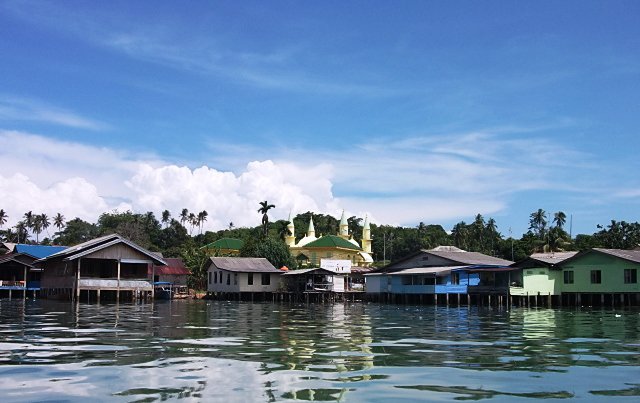
Penyengat Island

The architecture style combines the Malay, Arab, and India styles together. It is said that the masjid‘s wall was the mixture of red-bricks and albumin, which was used as the glue.

Feeling enough observing the elegance of the Great Masjid of Sultan Riau, you can move to other historical sites but, we recommend you to take a visit to several mausoleums of Riau-Lingga Sultanate staffers. There you can find the mausoleum of Engku Putri Raja Hamidah and Raja Ali Haji‘s graveyard. The most interesting one is the mausoleum of Raja Ali Haji because here, you can see one of his great literary works entitled Gurindam 12. You can read the whole series of Gurindam 12 that were carved out on the mausoleum‘s wall.

Move to another site, thus you will find an adat house where numerous royal properties of Riau-Lingga Sultanate are kept well within. In this Malay-style building, the Riau Islands people often hold some activities such as adat meetings and wedding parties. Moreover, the local inhabitants usually take some water from a spring located on the ground floor of the building. They do believe in the efficacies of the water, which can heal certain diseases. By the way, the water is believed to have ability of helping the one for getting a marriage partner soon.

Bukit Kursi Fortress, which was built during 1782 to 1784 A.D. when the Riau-Lingga Sultanate was under the role of Raja Ali Haji, is another must-be-visited site. The fortress was built facing directly to the sea, hence you can experience two travelling sensations at the same time, undergoing historical travelling and enjoying the turquoise sea water.

Penyengat Island Location

Penyengat Island is part of Riau Islands Province that includes administratively into Tanjungpinang Sub-district. To reach Penyengat Island, you can take water transportation called pompong from Sri Bintan Pura Port in Tanjungpinang City. It is hard to find any hotels and inns in the island. You can only spend the night at the local people‘s houses here. Likewise, public transportation such as busses and taxis is really hard to find. The best way to look around the island is taking benmor (motorized pedicab) with IDR 20.000/hour for its cost.

Wednesday, December 14, 2005

Shopping Center Book Market

Shopping Center Book Market

Your trip to Yogyakarta would be incomplete without visiting Yogyakarta book market that is better known as the “Shopping Center”. On Sriwedari Street, lines of kiosks displaying various books will be seen right away. Its existence as a book shopping center cannot be separated from the status of Yogyakarta as the city of education, in which tens or hundreds of state and private universities lie. Yogyakarta has become a melting pot of students coming from different areas of Indonesia and even Southeast Asia. The survival of the Shopping Center has of course been owing to the high reading tradition of Yogyakarta citizens.

“Book is the Window of the World”. Occupying a new place, Shopping Center has begun to carry the motto. It implies that reading is the best way to enrich our knowledge and that book reflects the cultural dynamics of a nation. The Shopping Center is becoming more and more important, along with the rapid growth of book publishing in Yogyakarta, either of local author or translated texts.
The new place has indeed only been operating since July 26, 2005. However, it actually houses hundreds of book vendors that have been working since 40 years ago or since 1970s. The Shopping Center has been moved several times due to city construction and eviction before settling in its permanent place in the cultural preservation area of Taman Budaya Yogyakarta. There are at least 124 kiosks neatly arranged in the two-story building. The vendors are affiliated in a Book Vendor Cooperation (Kopaku) Yogyakarta that was established in 1988.

Shopping Center Book Market


Being so well-known, in 1988 the Shopping Center, then was still in its old location, was paid a short visit by the Prime Minister of Malaysia, Dr. Mahathir Muhammad. The name of Shopping Center as a center for book vendors was quite big for Southeast Asia level at that time.

The Shopping Center is always crowded almost everyday and particularly on weekend. In fact, some of the visitors come from outside Yogyakarta. The book market often turns out to be the best alternative for book readers when, for example, a certain book is not available in other bookstores.
Books sold in the Shopping Center are new and used books. Each kiosk has its own specialty based on theme such as social, culture, religion, literature, textbooks, dictionary, and comic books. Not only that, Shopping Center also provides various neccesities for students such as news or article clippings, papers, thesis paper, and supplementary books for school and university.

Shopping Center Book Market


The book prices at Shopping Center are relatively cheaper compared to those at other bookstores. Why? Because generally, the vendors would only take a profit about 5 or 10 percent from publisher prices. Kiosk owners purchase books directly from distributors or book agencies, allowing them to get a discount of 25 to 35 percent. Here, bargaining is possible. This is another thing that distinguishes the Shopping Center from other bookstores.

Shopping Center Location

Shopping Center is situated right at the center of Yogyakarta, precisely at Sriwedari Street, Yogyakarta, Indonesia 55122. The location is on the east of Vredeburg Fortress and next to Taman Pintar and Taman Budaya Yogyakarta. On its north, there lies Beringharjo Market and Malioboro area.

It is easy to reach the Shopping Center since it lies downtown. Besides, the place is also relatively close to Adisucipto Airport (about 8 km away), Giwangan Bus Station (about 6 km), Lempuyangan Train Station (about 3 km), and Tugu Train Station (about 1 km).

Tourists who depart from Adisucipto Airport could take Trans-Jogja bus (route 3A or 3B) through Malioboro Street, costing Rp. 3000 (by October 2008). After 25 minutes, tourists could stop at Gedung Agung bus shelter. Shopping Center is only 300 m away and could be reached on foot. From Giwangan Bus Station, tourists could take a city bus route 2, 4, or 15 that would go through Malioboro as well. The bus fare is about Rp. 2.000 (by October 2008). Stop in front of Beringharjo Market or Taman Pintar, tourists could reach Shopping Center on foot, taking a 200 m walk. The Shopping Center is open seven days a week from 9 a.m. to 9 p.m and applies no entrance charge. Supporting facilities in the Shopping Center complex are a musholla (small mosque), toilet, and a shady and broad parking area.

Thursday, November 24, 2005

Liang Bua Cave

Liang Bua Cave
Liang Bua Cave

There is an assumption that Liang Bua Cave was shaped about 190.000 years ago. It is based on the result of laboratory research on the sediment at the south corner of the cave. It was shaped since the water stream from a river penetrating the surrounding hills. At the end, after a long run, those rocks shaped the formation of sedimentary rocks.

An archaeological excavation had ever been conducted by National Archaeological Research Centre in cooperation with University of New England in 2001. The result of the excavation was announced on October 28th, 2004 stating that hobbit fossil was discovered in the location. Such discovery then increases the visitors to Liang Bua cave.

Liang Bua Cave is one of the most important archaeological sites in the world. A fossil of Homo Floresiensis, which is 100 cm tall and 25 kg weight was discovered. It is assumed that the fossil is not taller than a five-years old boy. This fossil, whose the skull is just the same as a lemon fruit, is believed that such species lived about 13.000 years ago, together with giant lizards/ komodo and pigmi elephants.

Liang Bua Cave Location

Liang Boa Cave is located in Flores Island, Liang Bua Village, Ruteng Sub-district, in the district of Manggarai, East Nusa Tenggara Province, Indonesia. You can take air transports to reach the destination from Kupang City to Ende City, in Flores Island for about 1,5 hours. Then you must continue the trip to Ruteng City by public transportations for approximately 4 hours. From Ruteng Sub-district to Rampassa Village, the travel can be accessed by public transports or approximately 13 km away. Around the location, you can find restaurants or inns intended to offer you comfortable visit.

Friday, November 18, 2005

Tamansari Water Castle


Tamansari Water Castle is one of the cultural heritages of Yogyakarta Sultanate that stand hitherto. Tamansari was built during the reign of Sri Sultan Hamengku Buwono I, precisely in 1758. The castle has undergone several renovations to keep it beautiful without diminishing its original historic and aesthetic values. Tamansari lies not far from the Royal Palace of Yogyakarta, that is only 300 meter westwards.

The main object in the site is the pond. The pond is surrounded by 6 meter high walls as it was used as the bathing pond for the Sultan’s wives. There is a construction shaped like a tower in there. People say it was the place in which the Sultan used to watch his wives bathing.

On the front gate of Tamansari, there was a map that displays the site lay out in the past. The map shows that around the site, there was a fruit garden that the Sultan could pick fruits anytime. Among the fruits were watermelon, pineapple, and mango. With the garden, it could be easily imagined how cool and exquisite Tamansari was. However, it is impossible now to find such atmosphere there. Today, the surrounding of Tamansari has become people’s residences. They say the people living there are relatives of abdi dalem Kraton (royal servants) that inherited the houses from generation to generation.


Tamansari was built after the signing of Giyanti Treaty in 1755, that is after Sultan Hamengku Buwono came to terms with Sultan Pakubuwono III to end a long dispute. The building was intended to be a place for the Sultan to comfort mind, rest, and relax. However, Tamansari was also prepared to be a fort in case of danger and a place of worship, which is why in the Sumur Gumuling compartment there was a mushola (small mosque). The name Tamansari itself consists of two words, namely taman which means flower garden and sari which means beautiful. Thus, Tamansari was meant to be a complex of very beautiful garden.

Tamansari is only 0,5 km south of Yogyakarta Royal Palace. The architect was a Portuguese that the constructions embody much of European architectural art despite the Javanese symbols found in it. Yet, if observed carefully, Javanese architecture is actually dominant here. The construction was commenced by Sultan Hamengku Buwono I in the end of the 17th century. Tamansari was not only a royal garden, it was a recreational complex that consists of a bathing pond, water canals, rooms, and a big pond that would contain water if the canal is opened.

In brief, the compartments of Tamansari are as follows:


  • Sacred compartment. This part is a bit secluded from others and consists of a construction that used to be the Royal place for meditation.
  • Bathing pond. This part was where the Sultan and his family had a recreation. It constitutes two ponds that are divided by a kind of bridging path in between. The water flows from typical animal-shaped fountains. The pools is unique with some huge pots in it.
  • Pulau Kenanga compartment. This part consists of some constructions, namely Pulau Kenanga or Pulau Cemeti, Sumur Gumuling, and underground lanes.

Pulau Kenanga or Pulau Cemeti is a tall construction that functioned as a resting as well as spying place. This is the only construction that could be seen when the water canal is opened and the water flooding the compartment. It is said that if seen from above, the construction will look like a lotus in the middle of a very big pond. As soon as entering the site, visitors will find a big pond containing clear water fragmented into two smaller ponds. Beside this main pond, after descending the watching tower, visitors will find another small pond.

The pleasure of sitting relaxedly while looking at the ponds on the north and south side will be an experience visitors could relish on the tower of Tamansari. The breeze is slipping through the authentic wooden bars of the windows that have never been renovated since the first construction. Moreover, visitors could also enjoy looking at the surrounding residence that is believed to be once a fruit garden.

From upon the tower, visitors could go back down to continue the tour in Tamansari. In this compartment, there are an old-styled kitchen and a unique underground mosque. This mosque consists of two floors and is cylindrical with some hollow spaces on the walls as windows. There is a small round pond in the middle of the mosque compartment and a staircase above it. This part clearly has an elegant and artistic architecture. Furthermore, there is a tunnel that leads to some other passageways. One of the paths is believed to be a shortcut for the Sultan to go to the Southern Sea (Indian Ocean). On the north of the tunnel there is an old building that is still a part of the Tamansari complex. The building has two stories and is quite high. Upon it, visitors can see the surrounding beauty of the site. Here, visitors could at least for a while experience the luxury of being a Sultan.

Tamansari Location

Tamansari lies near the Yogyakarta Royal Palace, precisely on the southwest of the Palace or south of Ngasem Bird Market. Administratively, Tamansari is situated in Kampung Taman, the District of Keraton, Yogyakarta. From the Royal Palace, Tamansari can be reached on foot, which will take approximately 15 minutes, or by car, which will take around 5 minutes. Visitors can also go there by pedicab. There are many accesses to the site through small paths in the Kampung Taman. But if come by cars, it is better for the visitors to get to the site through the east gate as there is a wide parking lot.  Tourists can get a guide who will explain the history, meaning, and function of each construction in Tamansari. The tariff varies from Rp 25.000,- to Rp 50.000,-, depending on agreement between the tourist and guide. 

Saturday, November 12, 2005

Vredeburg Fort Yogyakarta


Taking a tour to Yogyakarta is incomplete without visiting Malioboro. However, do not get satisfied yet. If you have more time, take a walk to the southward of Malioboro street, to the zero point. This spot at the Grand Post Office (Kantor Pos Besar) intersection is the heart of Yogyakarta. There are several historical buildings here. They play an important role in the long history of Yogyakarta, even Indonesia. One of these buildings is the Vredeburg Fort.

Vredeburg Fort was once an unpretentious square fort built by Sri Sultan Hamengku Bowono I in 1760 upon the Colonial request, Nicolas Harting. This plain fort has 4 bastions, each corner is named Jayawisesa (northwest corner), Jayapurusa (northeast corner), Jayaprakosaning (southwest corner) dan Jayapranit (southeast corner).

When Nicolas was superseded by W.H Ossenberch in 1762, the Dutch persuaded the Sultan to construct the fort into permanent. The request was granted. The construction began in 1767 under the supervision of a Dutch constructor, Ir. Frans Haak. The construction finished in 1787. Then, it was named Rustenberg Fort, meaning “Fort for Resting”.


In 1867, Yogyakarta earthquake tore down Gedung Agung, Tugu Pal Putih (Yogya Monument) and Rustenberg Fort. As soon as the disaster over, Rustenberg was reconstructed and renamed Vredeburg Fort which means “Fort of Peace”. The name was chosen as a manifestation of the cease fire between Yogyakarta Sultanate and the Dutch. The name lasts hitherto.

Along with the political development in Indonesia, the ownership of Vredeburg Fort shifted many times. Initially, it belonged to the Sultanate in which the utilization was bequested to the VOC. VOC bankruptcy caused the fort governance to be taken over by Bataafsche Republic (the Dutch Government). When British ruled, the fort was under General Raffles governance, then it returned to the Dutch government before the Japanese arrival. After Indonesian independence, the fort automatically belonged to Indonesian government.

In August 9 1980, on Sri Sultan HB IX permission, Vredeburg Fort was made Center of Information and Development of Indonesian Culture. 12 years afterwards, in November 23, 1992, it officially became “Monumen Perjuangan Nasional” (National Struggle Monument) called “Vredeburg Fort Museum”. Nowadays, not only is it a museum, it is often used for art and cultural events.

If you picture Vredeburg Fort as a moldy and abandoned old building, you are mistaken. Vredeburg is clean and well taken care of. Although the inside has been renovated and adjusted to its new function as a museum, it still presents the sense of greatness of the past. The wide ditches which surround the fort make you take the linking bridge to enter the fort.

This square fort has control towers on each corner and entrenchment which was used by the Dutch army on their watch duty. On a clear dusk, you can see stunning view from above the fort. Thousands of swallows fly around the zero point, embellishing the twilight. In addition, the crisscrossing andong, becak, onthel; the flaring street and building lights around the point, give a profound impression on one of Jogja corners.

On the inside of the fort, there are thousands of dioramas portraying the Indonesian struggle before the independence until the New Order. There are also collections of historical objects, photographs and paintings about the national struggle to set, achieve, defend and fill Indonesian independence. The dioramas and collections of historical objects are equipped with information on the events which occurred at that time.

The rooms in the fort are often used for seminars, painting exhibitions and other cultural events. Annually, even, Vredeburg is appointed center of Yogyakarta Art Festival (FKY). Throughout a month Vredeburg will be live with various art performances. In addition to FKY, Festival Gamelan Gaul is also held annually here.

For you who love cycling, there is an onthel rent in the fort. You can cycle around only with Rp 5.000,-. If you carry a laptop with you, enjoy surfing the internet while sitting around the fine and shady fort yard. Vredeburg provides free Wi-Fi for visitors.

Vredeburg Fort Location

Vredeburg Fort is located across the President’s Residence, Gedung Agung, at 6 Ahmad Yani Street, Ngapusan Subdistrict, Gondomanan District, Special Region of Yogyakarta, Indonesia. Located at the heart of Yogyakarta, Vredeburg Fort is very accessible. Just walk southward of Tugu Train Station and Malioboro. But if you think it is too far, take a becak or andong.

If tourists depart from Adi Sucipto Airport, take Transjogja Route 1A and 3A, get off at Gedung Agung shelter. If depart from Jombor Bus Station tourists can take Transjogja Route 2A or the city bus lane 18 and 19. Or, from Giwangan Bus Station take Transjogja Route 3A or the city bus lane 4 and 10. Vredeburg complex has many facilities which are allowed for tourists or institutions and organizations to hold events. The facilities include the library, performance space, seminar hall, audio-visual and group study room, guest room, cooperative, prayer house and rest room. There is also free Wi-Fi. If tourists need a guide to get more information on the history of Vredeburg Fort, they can contact the management.

There also supporting facilities such hotels, restaurants, department stores, hospitals, internet centers, prayer houses and public transportations, approximately one kilometer outside the fort. If you have finished enjoying Vredeburg Fort, continue your trip to the historical buildings or tourist objects around the zero point. Some of them are Gedung Agung, the Grand Post Office, Bank of Indonesia Building, Taman Pintar, Taman Budaya Yogyakarta, Yogyakarta Palace and Kauman Great Mosque. They are located nearby and accessible on walk.

Friday, October 14, 2005

Yogyakarta Palace

Yogyakarta Palace

Yogyakarta Palace is the symbol of the heart of Javanese cultural civilization centered in Yogyakarta Province, Indonesia. Yogyakarta Palace, or known formally as Kraton Ngayogyakarta Hadiningrat, was built by Pangeran Mangkubumi titled Sultan Hamengku Buwono I in 1755 A.D. following the signing of Treaty of Giyanti. The present ruler of the Yogyakarta Sultanate is Kanjeng Gusti Pangeran Haryo titled Sultan Hamengku Buwono X. Likewise, he is a governor of Yogyakarta Province.

Inside the palace building, numerous historical properties of Yogyakarta Palace are kept well. There you can see some royal heirlooms, ancient books printed during the Dutch occupation, and hundreds of photographs depicting the historical journey of the palace from time by time.

Yogyakarta Palace


The royal palace complex is often used as the venue for traditional events. Some adat ceremonies as well as public events such as Grebeg Maulud, Jamasan, and many more are held at the palace complex.

So if you take a visit to the palace in a right moment, thus you can have two sensations of travelling to Yogyakarta Palace. You can watch the evidence of Yogyakarta Sultanate`s glory as well as enjoying adat ceremonies organized in the palace complex.


Yogyakarta Palace


Seldom do we find a palace that is still functioned as the heart of a kingdom or a royal administration in the present. Most of Indonesian palaces are now functioned as museums, no longer as the place for all royal activities. It is because a number of kingdoms in Indonesia cannot exist amidst the inexorable wave of globalization.

However, you can find a palace as well as a kingdom that is able to persist in this modern age. Only in Yogyakarta Palace you can find a palace that is functioned as both museum and the center for Yogyakarta Sultanate`s administrations.

Yogyakarta Palace Location

Yogyakarta Palace is located in the heart of Yogyakarta. It faces directly to the north Yogyakarta square, east of Malioboro Street. You can reach Yogyakarta Palace in ease as it lies in the heart of Yogyakarta City. There are two types of entrance tickets to the palace. To enter Pagelaran Kraton (the palace`s mansion), you need to pay IDR 5000; while for entering the innermost of the palace you get charged about IDR 7000 for the ticket. Hotels ranging from the lowest to the most expensive qualities are available in the location around the palace. Most of them are located in the area along the Malioboro Street as the Yogyakarta business center. There you can find souvenirs shops as well as typical foods of Yogyakarta in very ease with reasonable prices.

Friday, October 7, 2005

Lake Kelimutu

Lake Kelimutu
Visiting Lake Kelimutu

Lake Kelimutu, part of Kelimutu National Park, is situated on the peak of Mount Kelimutu which is at an altitude of 1.631 meters. Kinds of flora that you can find there are Kesambi (Schleichera oleosa), casuarinas tree (Casuarina equisetifoia), and Edelweiss. Moreover, types of fauna living around the lake are deer (Cervus timorensis), pig forest (Sus sp.), red jungle fowl (gallus gallus) and hawk (Elanus sp.).

There are three backwaters in the lake which tend to turn their colours. For instance, the water in one of those, change from red to bottle green then someday it can be pink and in another backwater, the water turn from bottle green into light green. The last one, the water can change from deep brown into azure.

Lake Kelimutu
There are three backwaters in the lake


Lake Kelimutu Location

Administratively, Lake Kelimutu is located in three sub-districts, Detsuko, Wolowaru, and Ndona Sub-district. It is in the district of Ende, East Nusa Tenggara Province, Indonesia.Administratively, Lake Kelimutu is located in three sub-districts, Detsuko, Wolowaru, and Ndona Sub-district. It is in the district of Ende, East Nusa Tenggara Province, Indonesia. 

Lake Kelimutu


Taking air transportation from Kupang, the capital of East Nusa Tenggara Province, to Ende District, it will be approximately 40 minutes to reach the destination. When you have arrived at Ende City, continue the journey by public transportations to Kaonara Village, about 93 km away or 3 hours. Then you must continue the trip to the location by walk for around 2,5 km. From February 2008 up to now, the entrance ticket of the lake is IDR 3.000. However, on weekend, the entrance ticket will be IDR 5.000.

Shelters, wide parking area and lodgements are some supporting facilities around the location. Hopefully it could make your vacation in the location comfortable.